


When You Have a Slab Leak, Which Repair Method Is Right for You?
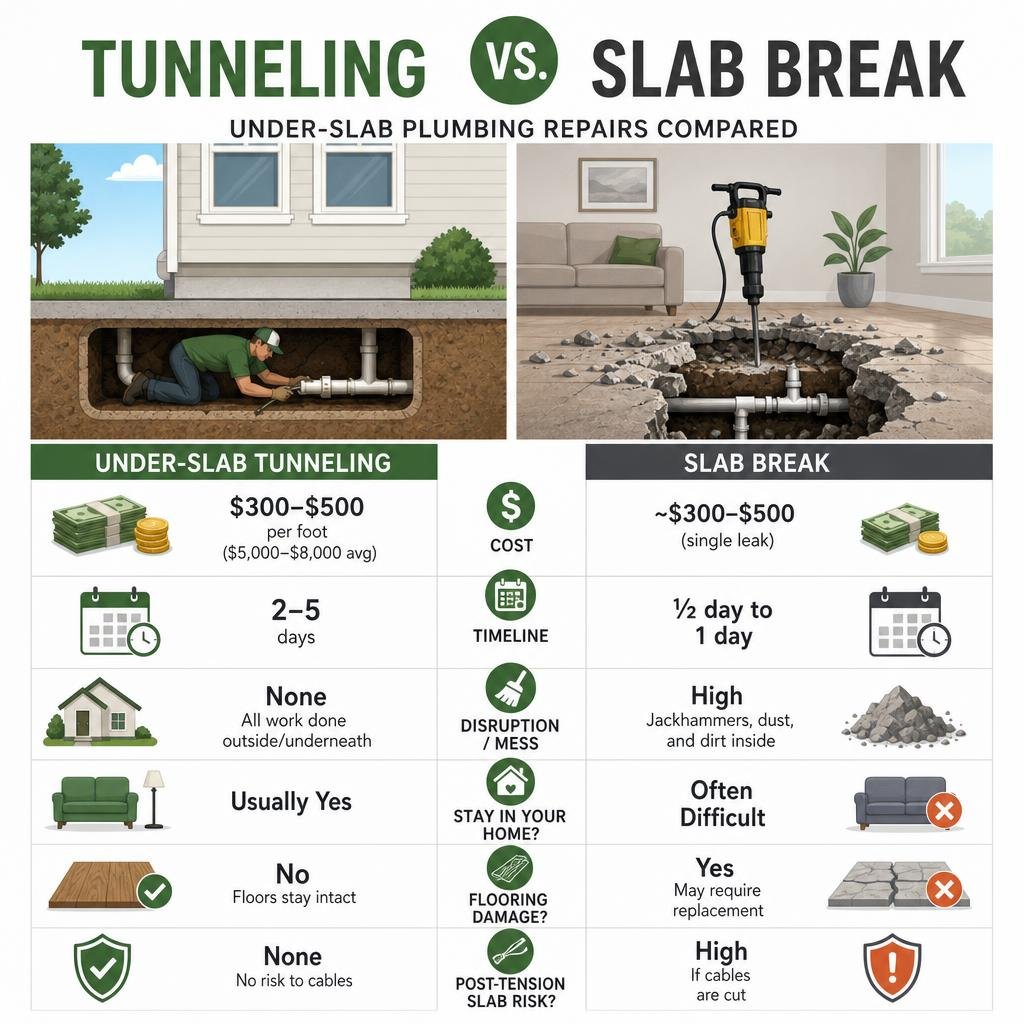
When it comes to tunneling vs slab break repairs, here’s the quick answer:
| Factor | Slab Break | Under-Slab Tunneling |
|---|---|---|
| Best for | Single, easy-to-reach leaks | Multiple leaks or expensive flooring |
| Upfront cost | ~$300–$500 (single leak) | $300–$500 per foot ($5,000–$8,000 avg) |
| Timeline | Half a day to 1 day | 2–5 days |
| Interior mess | High: jackhammers, dust, dirt inside | None: all work done outside/underneath |
| Stay in your home? | Often difficult | Usually yes |
| Flooring damage? | Yes: may require replacement | No |
| Post-tension slab risk? | High if cables are cut | None |
You’ve just found out there’s a plumbing leak under your slab. Now your plumber is asking whether to break through the floor or dig a tunnel underneath. It’s a stressful moment, and the wrong choice can cost you thousands more than you expected.
Breaking the slab is faster and cheaper upfront. But if there are multiple leaks, high-end flooring, or a post-tension foundation involved, that “cheap” fix can spiral quickly. Tunneling costs more to start, but it keeps your home livable, your floors intact, and your foundation untouched.
Neither method is the right answer every time. The best choice depends on your specific situation: the number of leaks, your foundation type, your flooring, and how much disruption your household can handle.
The Holloway Plumbing team has decades of experience handling slab leak repairs across the Texas Hill Country, and we have guided hundreds of homeowners through exactly this tunneling vs slab break decision. In this guide, we’ll walk you through everything you need to know to make the right call for your home.
Understanding the Core Difference: Tunneling vs Slab Break
Before we dive into the dirt, let’s clarify exactly what these two methods are.
When a plumbing pipe leaks beneath a concrete slab foundation, we cannot simply reach it. We have to create a path to the pipe.
- Slab breaking: This is the traditional “smash and grab” approach. We identify the general area of the leak inside your home, pull back your carpet, tile, or hardwood, and use a jackhammer to bust a hole directly through your concrete floor. We then dig down through the exposed dirt, fix the pipe, patch the concrete, and leave you to rebuild your floor.
- Under-slab tunneling: This is the minimally invasive alternative. Instead of coming from above, we start outside your home’s perimeter. We dig a trench next to your foundation and then excavate a horizontal tunnel directly underneath your concrete slab to reach the damaged pipe. Your floors, carpets, and quiet indoor life remain completely undisturbed.
The type of foundation your home sits on plays a massive role in this decision. In the Texas Hill Country, from Boerne to Kerrville and Fredericksburg, most modern homes are built on concrete slabs. Many of these are post-tension slabs, which are engineered with high-strength steel cables stretched tight inside the concrete. If a jackhammer accidentally nicks or cuts one of these high-tension cables, it can catastrophically damage the structural integrity of your entire foundation. Standard slab-on-grade foundations with rebar are more forgiving of a breakout, but they still require careful consideration.
Understanding your home’s warning signs is the first step. If you notice warm flooring, unexplained water bills, or foundation moisture, early slab leak repair services can help confirm the leak location before interior damage spreads. For urgent water under the foundation, Holloway Plumbing also provides emergency plumbing repairs for slab leaks throughout the Hill Country.
Breaking the Slab vs. Under-Slab Tunneling: Processes and Pros/Cons
Choosing between these two methods isn’t just a matter of flipping a coin. Each has a highly distinct process, along with its own set of advantages and disadvantages. Let’s pull back the curtain on how both methods work in the real world.
If your leak symptoms are still unclear, the warning signs in our article on spotting the signs of a slab leak can help you understand why warm floors, musty smells, or running-water sounds should not be ignored. Homeowners in older Hill Country properties may also benefit from our explanation of slab leak detection issues in older houses, especially when aging pipes complicate access decisions.
The Step-by-Step Slab Break Process
If you choose to break through the slab, here is what you can expect our team, or any professional plumbing team, to do:
- Isolate and protect: We start by sealing off the work area with plastic sheeting to contain the inevitable dust. We move furniture out of the room and lay down protective floor coverings.
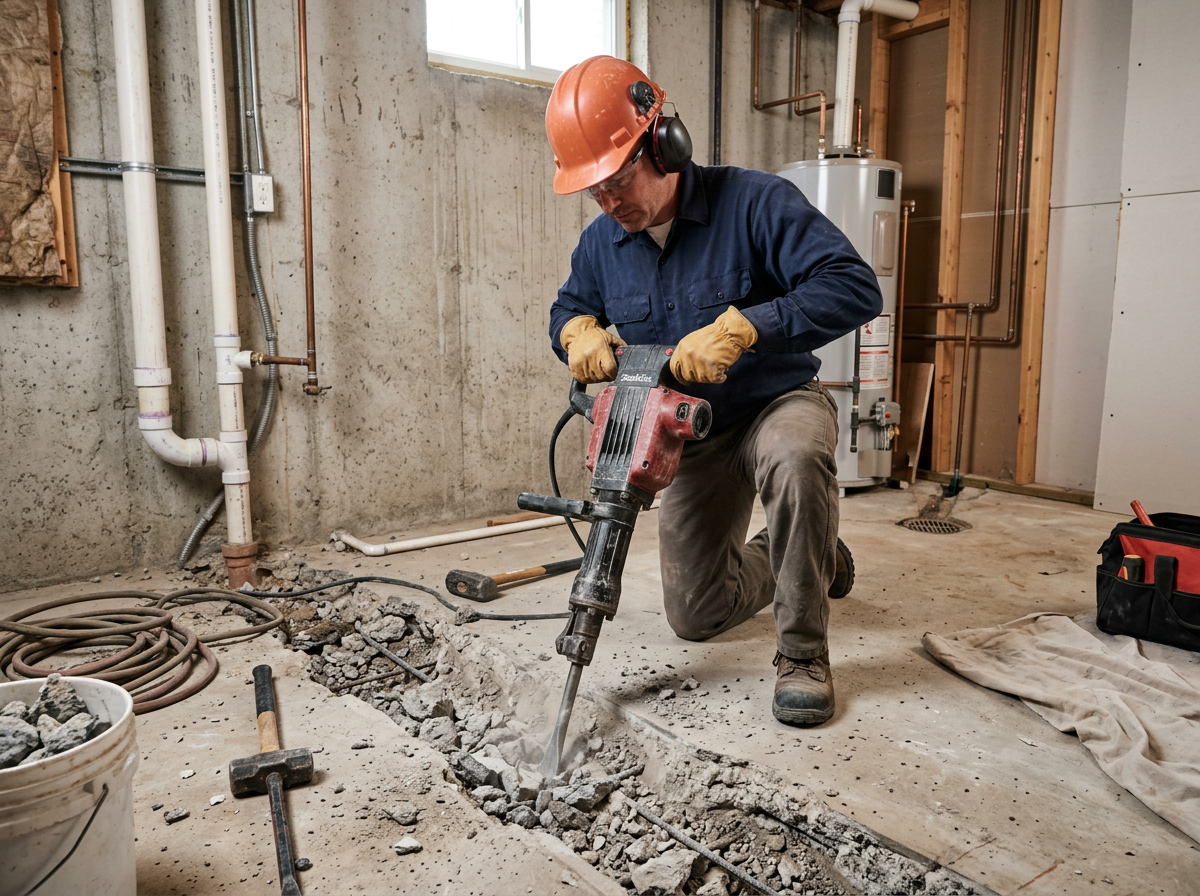
- Concrete cutting and jackhammering: Using a concrete saw and a heavy-duty jackhammer, we break a hole through your concrete floor. This is loud, vibrating, and incredibly dusty work.
- Dirt excavation: We shovel out the dirt underneath the broken concrete by hand, placing it into buckets or wheelbarrows to carry out of your home.
- Pipe repair: Once the pipe is fully exposed, we cut out the damaged section and install a durable, modern replacement pipe.
- Backfilling and compacting: We shovel the dirt back into the hole and compact it as tightly as possible.
- Concrete patching: We pour fresh concrete into the hole, smooth it out, and let it cure. This patch typically takes about 24 hours to dry completely before you can even think about restoring your flooring.
Pros and Cons of a Slab Break
The pros:
- Lower upfront cost: For a single, isolated leak that is easy to locate, breaking the slab is highly economical. The physical breakout process typically costs only $300 to $500.
- Fast execution: A straightforward slab break and repair can often be finished in half a day to one full day.
- Proven patch durability: Some homeowners worry that a patched slab is structurally weak. However, in over 21 years of professional experience across the industry, we have seen only one interior concrete patch fail, and that includes patches in garages that support heavy vehicles daily.
The cons:
- Massive interior mess: No matter how much plastic sheeting we use, fine concrete dust has a way of settling on everything.
- Flooring replacement costs: If you have seamless hardwood, custom tile, or out-of-production flooring, matching the patch area can be impossible. You may end up paying thousands of dollars to replace the flooring in the entire room.
- Post-tension risks: One wrong move with a jackhammer can snap a post-tension cable, resulting in an incredibly expensive structural repair.
The Step-by-Step Under-Slab Tunneling Process
Tunneling is a highly skilled, carefully engineered process. Here is how we execute it:
- Access pit excavation: We start outside your home, usually in a flowerbed or yard adjacent to the foundation. We dig a vertical access pit about 3 to 4 feet deep.
- Hand digging the tunnel: Our specialized crew digs horizontally underneath your foundation beam. These tunnels are small, tight spaces, typically 3 feet wide and 3 feet tall, just large enough for a technician to crawl through.
- Pipe repair: We crawl under the home with specialized tools, locate the leaking pipe, cut away the bad section, and replace it.
- Backfilling and mud pumping: Once the repair is complete and tested, we pack the dirt back into the tunnel. To ensure there are no empty pockets, or voids, that could cause your foundation to settle, we use a process called mud pumping or slurry backfilling, forcing a wet soil-cement mixture into the remaining spaces.
During the excavation phase, structural integrity is paramount. Underground voids and soil displacement can stress overhead structures, which is why professional tunneling must be done carefully, step by step, to prevent ground settlement.
Pros and Cons of Under-Slab Tunneling
The pros:
- Zero interior disruption: No jackhammers inside, no dust, no mud on your carpets. Your family can watch TV, cook dinner, and sleep in peace while we work outside.
- Flooring preservation: Your beautiful hardwood, custom tile, or expensive stone flooring remains completely untouched.
- Slab integrity: We do not cut or weaken your concrete slab, making this the safest option for post-tension foundations.
- Sewer upgrades: If your older home has failing cast iron pipes, tunneling gives us the space to replace entire runs of bad pipe at once. In those cases, sewer line repair and replacement can address more than one failing section without tearing up finished floors.
The cons:
- Higher cost: Tunneling is incredibly labor-intensive. It typically costs $300 to $500 per foot, meaning a 15-foot tunnel can quickly reach $5,000 to $8,000.
- Longer timeline: Because everything is dug by hand, tunneling usually takes 2 to 5 days to complete.
Head-to-Head Comparison: Cost, Timeline, and Disruption
To help you visualize how these two methods stack up when they go head-to-head, let’s look at a direct comparison table:
| Feature | Slab Breaking | Under-Slab Tunneling |
|---|---|---|
| Upfront cost (access only) | $300 – $500 total | $300 – $500 per linear foot |
| Average total project cost | $1,500 – $3,500 (plus flooring) | $5,000 – $8,000 |
| Project timeline | 1/2 to 1 day | 2 to 5 days |
| Noise and vibration | Extreme (indoors) | Moderate (outdoors only) |
| Dust and cleanup | High indoor cleanup required | None indoors; minor yard restoration |
| Home livability | Extremely difficult; may need to relocate | High; stay in your home |
Cost and Timeline Differences in Tunneling vs Slab Break
When evaluating costs, it is important to look at the big picture. While the initial slab break only costs a few hundred dollars, the secondary costs, like replacing high-end tile or wood flooring, can easily close the gap.
Tunneling typically costs $300 to $500 per foot, leading to an average total project cost of $5,000 to $8,000. The process takes 2 to 3 days on average.
If both options sound too invasive, there is often a third alternative: pipe rerouting. Instead of digging under or breaking through your slab, we run brand-new copper or PEX water lines through your walls or attic, completely abandoning the leaking pipe under the concrete. Pipe rerouting averages $4,000 to $6,000 and usually takes only 1 to 2 days, making it a highly popular, budget-friendly middle ground for water line leaks.
Disruption, Flooring, and Cleanup in Tunneling vs Slab Break
The psychological toll of a slab break is often underestimated. Jackhammering inside a home creates a deafening noise that makes working from home or relaxing impossible. If you have pets, small children, or tenants in a rental property, you will almost certainly have to pay for temporary relocation.
With tunneling, all the mess stays outside in the dirt. Your daily routine remains 100% normal. When a less invasive option is available, techniques like trenchless point repair for pipe problems can reduce household disruption while still addressing damaged underground lines.
Key Decision Factors and Long-Term Foundation Integrity
When we dig a tunnel under a house, we are temporarily removing the soil that supports your foundation. This is why long-term structural integrity must be a primary focus.
In engineering, soil compaction is measured using the Proctor Density test, which typically specifies reaching 90% to 95% of maximum soil density. Because mechanical soil compactors cannot physically fit inside a tight 3×3-foot tunnel, we cannot rely on standard compaction methods.
This is where mud pumping or slurry backfilling becomes vital. Instead of simply shoveling loose dirt back into the tunnel, which will inevitably settle over time and leave massive empty voids, we pump a pressurized flowable fill, or slurry, made of soil, cement, and water. This slurry flows into every nook and cranny, hardening to provide rock-solid support directly beneath your concrete beam.
While concrete slabs are engineered to span minor soil voids without cracking, proper backfilling is essential in the shifting clay soils of the Texas Hill Country to prevent long-term foundation settling. For more on trenchless and underground repair pros and cons, our article on the pros and cons of trenchless sewer repair explains when excavation can be avoided and when direct access is still necessary.
When Breaking the Slab Makes More Sense
Breaking through your concrete slab is often the smartest, most logical choice if:
- The leak is isolated and easily accessible: If we know exactly where the leak is and it sits under a low-impact area like a garage floor, a utility room, or cheap carpet, breaking the slab is fast and highly cost-effective.
- You are on a tight budget: If upfront funds are limited, a slab break gets your water turned back on for a fraction of the cost of tunneling.
- You are already planning a remodel: If you were already planning to tear up your old tile and put down new flooring, breaking the slab won’t cause any additional flooring headaches.
When Tunneling is the Superior Choice
Tunneling is undoubtedly the better choice if:
- You have a post-tension foundation: Preserving your structural cables should be your number one priority.
- You have expensive, seamless flooring: If replacing your custom hardwood or imported tile would cost thousands of dollars, paying more for tunneling upfront actually saves you money in the long run.
- You cannot leave your home: If you run a home business, have elderly family members, or own a rental property with active tenants, tunneling allows everyone to stay put.
- You have multiple leaks: If you have multiple plumbing failures, breaking the slab would turn your home into a Swiss cheese block of concrete patches. Tunneling allows us to access and repair multiple areas from a single underground path.
Removing support material during excavation changes how weight and pressure move through the soil beneath a structure. This is why high-quality mud-pump backfilling is so critical when choosing the tunneling route.
Frequently Asked Questions about Under-Slab Repairs
Does insurance cover tunneling vs slab break?
This is one of the most common questions we get. Standard Texas homeowners insurance policies typically do not cover the actual cost of repairing the plumbing pipe itself, which is usually a few hundred dollars. However, many policies do cover the “cost of access,” the expensive work required to reach the pipe.
Whether your insurance company covers tunneling versus slab breaking depends entirely on your specific policy. Because insurance companies prefer the least expensive solution, they may only agree to pay the equivalent cost of a slab break. If tunneling costs $6,000 and a slab break costs $2,000, they might only cut a check for $2,000, leaving you to cover the difference. Always call your insurance adjuster to verify your “access coverage” before committing to a repair method.
Can a homeowner DIY under-slab tunneling?
We strongly advise against this. While it might look like simple dirt work, tunneling under a heavy concrete foundation is incredibly dangerous.
Without proper shoring, a tunnel can collapse, trapping you underneath your own home. Furthermore, professional crews know how to navigate around electrical conduits, gas lines, and other buried utilities. In one famous industry case, an ambitious homeowner attempted to DIY their own under-slab tunnel; it took them 6 months of backbreaking labor to complete a job that our professional crews finish in one week. Save your back, and your life, and leave the tunneling to the pros.
Is mudjacking safe for backfilling plumbing tunnels?
No. While mudjacking is a great technique for leveling sunken concrete sidewalks or driveways, it should never be used to fill voids around plumbing pipes.
Mudjacking slurry cures into an incredibly dense, rock-hard material. In the highly expansive clay soils of the Texas Hill Country, our soil swells when wet and shrinks when dry. If a pipe is encased in rock-hard mudjacking material, the shifting soil will lock the pipe in place, causing it to snap and break all over again. Instead, we use a specialized, flexible soil-cement slurry that supports the foundation without putting destructive stress on your plumbing lines.
Conclusion
At the end of the day, there is no single “winner” in the tunneling vs slab break debate. If you have a single leak under a garage floor, breaking the slab is a fast, affordable home run. But if you have multiple leaks under a gorgeous, custom-tiled living room, under-slab tunneling is the clear champion that saves your home from becoming a dusty construction zone.
At Holloway Plumbing, we have spent nearly 50 years providing honest, reliable, and expert plumbing services to our neighbors throughout the Texas Hill Country, including Kerrville, Boerne, Fredericksburg, Bandera, and Comfort. We don’t believe in one-size-fits-all solutions. Our team uses advanced leak detection technology to locate your problem with pinpoint accuracy, and we will walk you through the pros, cons, and exact costs of both methods for your specific home.
If you suspect you have a slab leak, don’t wait for the water damage to get worse. Contact our professional slab leak repair technicians today to schedule an expert foundation inspection. We’re here to help you protect your home, your foundation, and your peace of mind.