


What Hard Water Does to Your Water Heater (And Why It Matters in Hunt, TX)
If you have a hard water water heater problem, here’s the short answer:
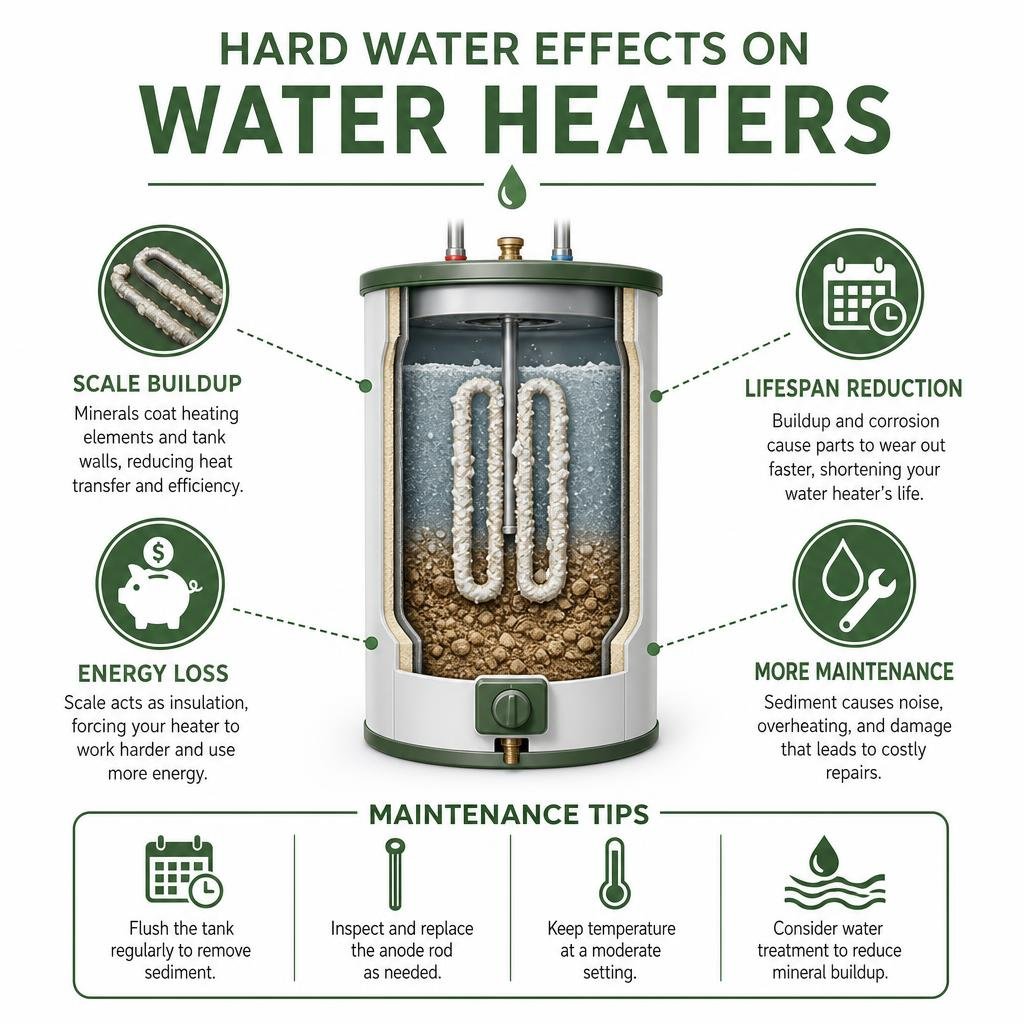
Hard water deposits calcium and magnesium minerals inside your water heater. Over time, this scale buildup forces your heater to work harder, drives up energy bills, and cuts its lifespan nearly in half.
“`html
| Effect | What Happens |
|---|---|
| Scale on heating elements | Insulates heat, reduces efficiency by 15–25% |
| Sediment at tank bottom | Causes overheating, popping noises, and tank damage |
| Anode rod depletion | Rods wear out 2–3x faster, leaving the tank unprotected |
| Lifespan reduction | From 12–15 years down to as few as 4–8 years |
| Higher energy bills | Scale forces longer run times and wastes fuel |
“`
About 80% of American homes receive hard water, and in Texas Hill Country communities like Hunt, TX, the problem is especially severe. Water drawn from the Edwards Aquifer passes through layers of limestone, picking up calcium and magnesium along the way. That mineral-loaded water flows straight into your water heater, where heat accelerates the damage.
The result? Scale builds up faster than most homeowners realize. A water heater that should last over a decade can fail in just a few years without the right protection and maintenance.
At Holloway Plumbing, our team has seen how hard water ages water heaters prematurely across the Texas Hill Country, often long before homeowners suspect a problem. In the sections below, we’ll walk you through exactly what’s happening inside your tank and what you can do to stop it.
The Science Behind How a Hard Water Water Heater Degrades
To understand why a hard water water heater struggles so much, we have to look at the chemistry taking place inside the tank. Every time your water heater turns on, a silent chemical reaction occurs.
As cold water enters the tank, it carries dissolved minerals. When this water is heated to typical household temperatures, usually between 120°F and 140°F, it triggers thermal decomposition. Dissolved calcium bicarbonate breaks down into solid calcium carbonate, commonly known as limescale.
Unlike most solids, which dissolve more easily as temperatures rise, calcium carbonate exhibits inverse solubility. This means that as the water gets hotter, the minerals become less soluble and precipitate out of the liquid much faster. The hottest areas inside your heater, the metal surfaces of the heating elements or the bottom of a gas tank directly above the burner, become magnets for scale formation.
This mineral layer acts as an incredibly effective thermal insulator. While steel has a thermal conductivity of around 50 W/m·K, limescale’s thermal conductivity is a measly 0.5 to 2.5 W/m·K. This means scale can block heat transfer up to 100 times more than the metal tank itself. If you are noticing that your hot water isn’t as hot as it used to be, or if your bills are climbing, it might be time to call for professional water heater services in Kerrville, TX to assess the damage.
Calcium and Magnesium Precipitation
The primary culprits behind this scale formation are:
- Calcium carbonate: The chalky white substance that coats heating elements and settles at the bottom of the tank.
- Magnesium hydroxide: Often working alongside calcium to form a rock-hard mineral matrix.
- Silica: A glass-like compound found in some groundwater sources that is highly resistant to traditional chemical descaling.
In Hunt, TX, and surrounding Hill Country areas, our water primarily originates from local aquifers. As rainwater filters down through limestone and dolomite formations, it becomes heavily saturated with these minerals. Water hardness is typically measured in grains per gallon (GPG) or parts per million (PPM).
The Water Quality Association classifies water above 10.5 GPG as “very hard.” In many parts of the Texas Hill Country, including Fredericksburg, Boerne, and Bandera, groundwater measurements easily exceed 15 to 20 GPG. To protect your home’s appliances from these extreme levels, monitoring your water quality is a vital first step. Installing a high-quality water softener or filtration system is often necessary to prevent these minerals from precipitating in your plumbing.
The Role of pH and Corrosive Water
While hard water mineral buildup is the most common threat, the chemical balance of your water can cause issues at both ends of the spectrum. If your water has low pH levels below 7.0, it is considered acidic. Acidic water is highly corrosive and actively eats away at metal components, including copper pipes, heating elements, and the steel tank lining itself.
When corrosive water pairs with high mineral content, it creates a double-whammy: scale builds up unevenly, trapping pockets of water against the metal surfaces. This creates localized “hot spots” that accelerate copper corrosion and lead to premature tank leaks. Many homeowners first notice the problem when they start asking why their water heater is leaking, but the real cause may be a combination of scale-induced thermal stress and unchecked corrosion.
The Mechanical Toll of Scale on Tank and Tankless Systems
When scale forms inside a water heater, it doesn’t just sit there quietly. It takes a heavy mechanical toll on every moving part, sensor, and heating surface.
As the insulating scale layer thickens, the heat transfer from the burner or element to the water is severely restricted. To achieve the target temperature on your thermostat, the water heater must run for significantly longer periods. This drop in thermal conductivity translates directly to skyrocketing energy bills.
Even worse, because the heat cannot easily escape into the water, the internal components of the water heater overheat. The metal surfaces of the tank and the heating elements are subjected to extreme temperatures far beyond their design limits, leading to rapid physical degradation. If your system is already showing signs of strain, scheduling a professional water heater repair can help prevent a total system shutdown.
Traditional Tank Lifespan and Efficiency Loss
In a traditional tank-type water heater, scale flakes off the heating elements or precipitates out of the water and settles to the bottom of the tank. This creates a thick layer of sediment accumulation. Just one inch of sediment at the bottom of a tank can reduce heating efficiency by 15% to 25%, forcing a gas burner to burn hotter and longer just to heat the water above it.
Over time, this intense heat causes the steel tank bottom to expand and contract excessively. This thermal stress eventually cracks the protective glass lining of the tank. Once the glass lining is compromised, water contacts the bare steel, leading to rust, pinhole leaks, and eventual tank rupture. For busy households, this accelerated wear and tear makes timely water heater replacement in family homes a critical consideration before a catastrophic leak occurs. Untreated hard water can slash a standard tank’s lifespan from a healthy 10–12 years down to a mere 4–6 years.
Tankless Water Heaters in Hard Water Conditions
Many homeowners switch to tankless systems assuming they will avoid sediment issues. However, tankless water heaters are actually more vulnerable to hard water damage because of their compact design.
| Feature | Traditional Tank | Tankless Water Heater |
|---|---|---|
| Water Passages | Large, open tank | Very narrow copper heat exchanger tubes |
| Surface Temperature | Moderate, spread over a larger area | Extremely high, concentrated in a small space |
| Scale Accumulation | Settles loosely at the bottom | Bakes directly onto the tube walls |
| Failure Mode | Tank rusts out and leaks | Flow restriction, overheating, and system error codes |
| Maintenance Need | Annual flush | Descaling every 6–12 months depending on GPG |
Because tankless systems rely on rapid heat transfer through narrow passages, even a tiny 1/16-inch layer of scale inside the heat exchanger can restrict water flow, drop efficiency by over 10%, and trigger automatic safety shutdowns due to overheating. If you have or are considering a tankless unit, it helps to understand the unique care requirements that come with high-efficiency equipment.
Gas vs. Electric Heating Element Vulnerabilities
Gas and electric water heaters fail differently when subjected to hard water scale:
- Electric water heaters: Scale forms directly on the electric heating elements. As the scale thickens, it completely insulates the element. The heat becomes trapped inside the metal sheath, causing the internal resistance wire to melt and burn out. If your hot water suddenly stops working, a burnt-out electric element may be the most likely suspect.
- Gas water heaters: Scale accumulates at the bottom of the tank, directly above the gas burner. Water gets trapped beneath this heavy layer of sediment and boils instantly, creating pockets of steam. When these steam bubbles collapse, they produce distinct rumbling, popping, or banging noises, a phenomenon known as the “kettle effect.” This constant micro-boiling physically rattles the tank, weakening joints and accelerating mechanical fatigue.
Recognizing and Diagnosing Mineral Damage
Identifying mineral damage early can save you thousands of dollars in premature replacement costs. Fortunately, your plumbing system usually drops several hints before a total breakdown occurs.
A thorough visual inspection of your home’s fixtures is a great place to start. If you see white, crusty deposits on your showerheads, aerators, and faucets, you can guarantee the exact same scale is building up inside your water heater. Furthermore, as scale restricts the hot water outlet pipes, you may notice a significant drop in hot water pressure compared to your cold water pressure. If you are experiencing uneven pressure throughout your home, it is wise to consult an expert on water pressure plumbing to pinpoint the blockage.
Warning Signs Your Hard Water Water Heater Needs Immediate Attention
Keep your eyes and ears open for these classic warning signs:
- Strange noises: Popping, cracking, or rumbling sounds coming from the utility closet are a clear sign that sediment has built up at the bottom of your tank.
- Lukewarm water: If your hot showers are getting shorter or the water never seems to reach its target temperature, scale has likely insulated the heating elements.
- Cloudy or gritty water: If the hot water coming out of your tap looks muddy or contains tiny white flakes, sediment is actively breaking loose inside the tank.
- Frequent element failure: If you have an electric unit and find yourself replacing the heating elements every year or two, hard water is the undisputed culprit.
Ignoring these warning signs can lead to severe structural damage. Minor sediment issues can escalate into leaks, water damage, and emergency replacement if scale is allowed to trap heat against the tank.
Testing Your Water Quality in Hunt, TX
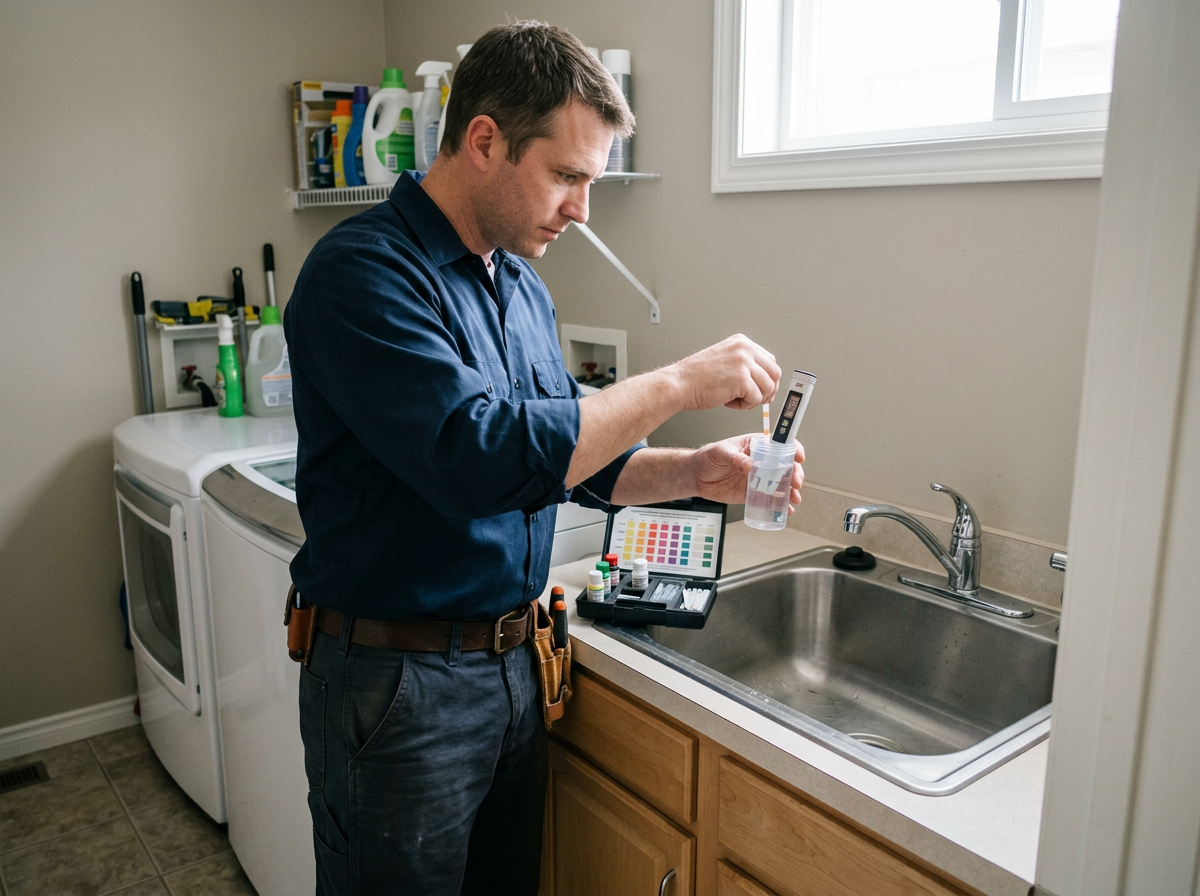
To determine the best defense strategy, you need to know exactly what is in your water. You can purchase a simple, inexpensive DIY water test kit from a local hardware store to measure your water’s pH and hardness in grains per gallon (GPG) or parts per million (PPM).
For a more comprehensive analysis, our team can perform professional water testing. We measure hardness, iron content, total dissolved solids (TDS), and pH levels to design a customized filtration or softening system tailored specifically to your home.
Mitigation Strategies and Industry Innovations
Living in a hard water region like the Texas Hill Country doesn’t mean you are doomed to replace your water heater every few years. By implementing the right water treatment and choosing modern, hard-water-resistant appliances, you can easily protect your investment.
While the upfront cost of installing water treatment equipment might seem high, the long-term prevention costs are incredibly low compared to the price of replacing ruined appliances, fixing corroded pipes, and paying inflated energy bills month after month. Investing in water treatment systems is the single most effective way to safeguard your entire home’s plumbing.
Choosing the Right Hard Water Water Heater Solutions for Your Home
When it comes to neutralizing hard water, you have two primary options:
- Traditional ion-exchange water softeners: These systems use salt to swap hard calcium and magnesium ions with harmless sodium ions. This completely eliminates scale formation, keeping your water heater running at peak efficiency. If you’re ready to make the switch, our team can help with professional water softener installation for Hill Country homes.
- Template-assisted crystallization (TAC): A salt-free alternative that doesn’t actually remove minerals but changes their physical structure. TAC systems bind calcium and magnesium into microscopic crystals that cannot stick to metal surfaces, preventing scale buildup without adding salt to your water.
Advanced Tank Linings and Sediment Mitigation Technologies
If you are in the market for a new water heater, look for models designed specifically to handle high-mineral water. Brands like Bradford White water heaters feature proprietary Vitraglas® tank linings, which provide superior protection against corrosion, and the Hydrojet® Total Performance System, which uses a specially designed dip tube to create a turbulent, swirling water flow that prevents sediment from settling at the bottom of the tank.
Additionally, we highly recommend and service a wide variety of top-tier brands engineered for durability, including:
- State water heaters
- AO Smith water heaters
- Rheem tank type water heaters
- Ruud water heaters
- American water heaters
- Whirlpool gas water heaters
- Bosch water heaters
If scale has already caused symptoms, two helpful blog resources are especially relevant before you decide whether to repair or replace the unit. Our article on why your water heater is leaking explains how corrosion, pressure, and tank damage often show up, while our guide to the benefits of installing a water softener system explains how softening protects appliances throughout the home.
Maintenance Schedules and Flushing Protocols
Even with a water treatment system in place, regular maintenance is non-negotiable.
For standard tank water heaters, we recommend a professional flush at least once a year, or every six months if you have extremely hard, untreated water. Flushing clears out loose sediment before it can bake into a solid, rock-hard crust.
For tankless systems, a periodic chemical descaling using a food-grade citric acid or vinegar solution is required to keep the narrow heat exchanger passages clear. During our maintenance visits, we also test the temperature and pressure (T&P) relief valve and inspect the sacrificial anode rod to ensure your system is completely safe and fully protected.
Frequently Asked Questions about Hard Water Damage
How long does a water heater last in Hunt, TX without maintenance?
In areas with untreated, highly mineralized water like Hunt, TX, an unmaintained tank-style water heater typically lasts only 4 to 6 years before failing due to element burnout, severe efficiency loss, or a ruptured tank. In contrast, a properly maintained heater in a home with soft water can easily last 12 to 15 years.
Does a water softener completely eliminate the need for flushing?
While a water softener removes up to 99% of scale-causing minerals, it does not completely eliminate the need for annual maintenance. Softeners can occasionally run out of salt, experience mechanical malfunctions, or bypass during regeneration cycles, allowing small amounts of minerals to enter the tank. Furthermore, softened water can actually accelerate the consumption of your water heater’s sacrificial anode rod. Regular inspections are still necessary to ensure the rod is intact and protecting your tank from rust.
Can hard water damage void my water heater’s warranty?
Yes, absolutely. Most major water heater manufacturers explicitly state in their warranty guidelines that damage caused by scale buildup, sediment accumulation, or operating the unit outside of recommended water quality limits constitutes neglect. If a technician finds that your heating elements burned out or your tank ruptured because it was choked with three inches of calcium, the manufacturer will likely deny your warranty claim.
Conclusion
A hard water water heater doesn’t have to be a ticking time bomb in your utility closet. While the mineral-rich water of the Texas Hill Country presents a constant challenge, a proactive combination of water softening, choosing high-quality equipment, and scheduling regular maintenance can keep your hot water flowing reliably for many years to come.
At Holloway Plumbing, we have provided residential and commercial plumbing services, including 24/7 emergencies, to our neighbors in the plumbing industry for decades. Serving Hill Country, Texas, our unique selling proposition is nearly 50 years of reliable, fast, expert service trusted by locals.
Whether you are in Hunt, Kerrville, Fredericksburg, Boerne, Bandera, Ingram, Fair Oaks Ranch, Comfort, Center Point, Mountain Home, Pipe Creek, or Harper, we are here to help you conquer your hard water challenges.
Ready to protect your water heater or schedule a professional system flush? Contact our professional water heater technicians today to book your appointment.