


Why Getting Your Water Heater Size Right Matters More Than You Think
A water heater sizing guide helps you match your unit’s capacity to your household’s actual hot water needs, so you never run cold mid-shower or waste money heating water you don’t use.
Quick answer: what size water heater do you need?
| Household Size | Storage Tank (Gas) | Storage Tank (Electric) | Tankless (GPM) |
|---|---|---|---|
| 1-2 people | 30-40 gal | 40-50 gal | 4-6 GPM |
| 3-4 people | 40-50 gal | 50-65 gal | 6-8 GPM |
| 4-5 people | 50-65 gal | 65-75 gal | 7-9 GPM |
| 6+ people | 75+ gal | 80+ gal | 9-11 GPM |
These are starting points only. Your actual size depends on peak usage, fuel type, and your local groundwater temperature.
The right size isn’t just about comfort. An oversized tank wastes energy running 24/7 to keep water hot that nobody uses. An undersized unit wears out faster, sometimes failing years early, and leaves your family fighting over who gets the last hot shower.
Most homeowners make the mistake of simply replacing their old unit with the same size. But that unit may have been wrong to begin with, or your household’s needs may have changed.
The single most important number for tank water heaters isn’t tank volume. It is the First Hour Rating (FHR), which tells you how much hot water the unit can deliver during your busiest hour. For tankless heaters, it’s gallons per minute (GPM) at your local temperature rise.
At Holloway Plumbing, our team has spent decades serving Hill Country homeowners, and we have seen that a proper water heater sizing guide prevents more cold-shower emergencies than any repair call ever could. Let’s walk through exactly how to get it right.

The Ultimate Water Heater Sizing Guide: Tank vs. Tankless Systems
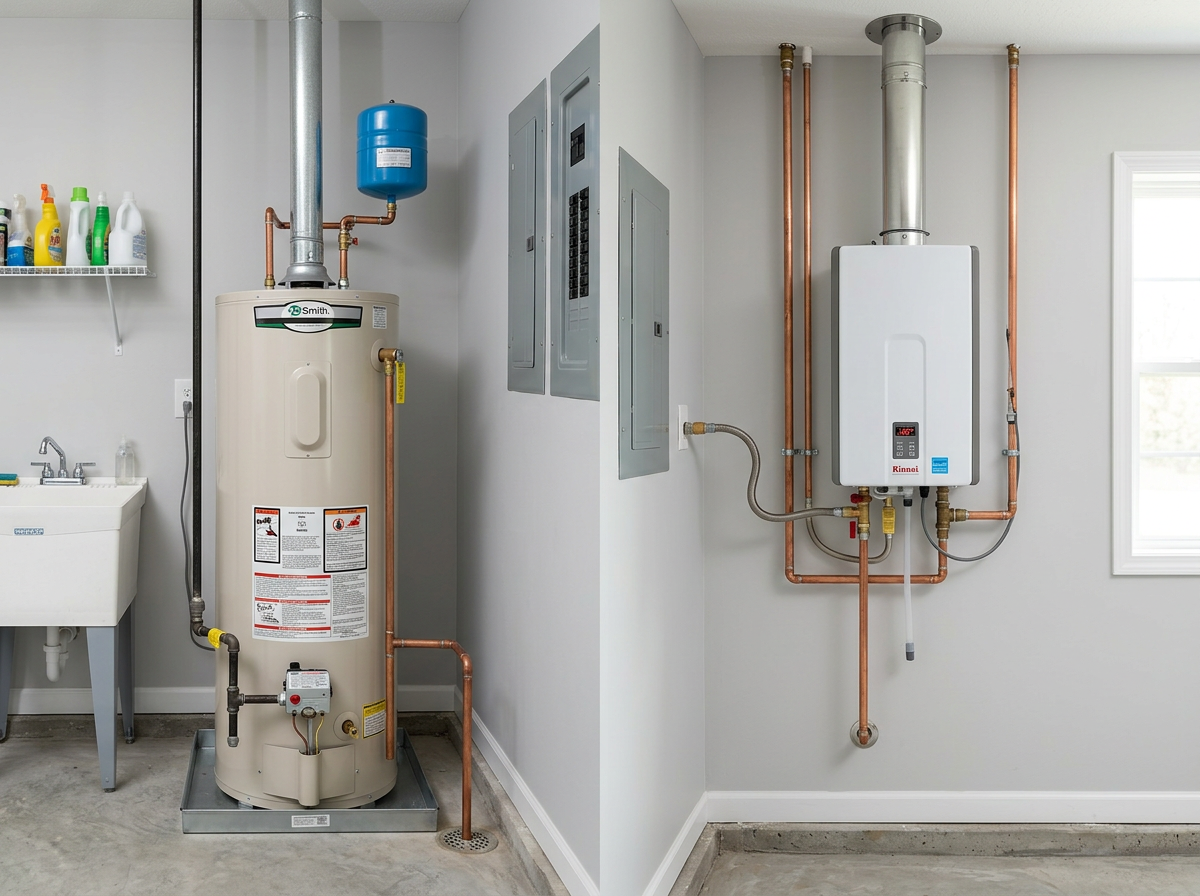
When selecting a new water heater, the first step is understanding that storage tank systems and tankless demand-type systems operate on entirely different engineering principles. Consequently, sizing them requires completely different metrics.
A traditional storage tank water heater maintains a reservoir of hot water at a constant temperature, ready for use. Sizing a tank system is a matter of calculating how much hot water you need stored and how fast the system can replenish that supply.
Conversely, tankless water heaters do not store water. They heat water instantly as it flows through a high-powered heat exchanger. Sizing a tankless system is about matching the unit’s heating capacity to the maximum rate of water flowing through your fixtures at any given moment.
According to the sizing guidelines for a new water heater from the Department of Energy, a properly sized system ensures peak efficiency and minimizes standby energy losses. Whether we are installing a system in a historic home in Fredericksburg or a new build in Boerne, selecting the right technology is the foundation of long-term satisfaction.
Sizing Storage Tank and Heat Pump Water Heaters
For storage tank systems, including energy-efficient heat pump hybrid water heaters, the key metric is the First Hour Rating (FHR). The FHR is the number of gallons of hot water the heater can supply per hour, starting with a fully heated tank. You can find this rating in the top left corner of the federal EnergyGuide label.
FHR is determined by two factors:
- Tank Capacity (Volume): The physical amount of water the tank holds, such as 40, 50, or 80 gallons.
- Recovery Rate: The speed at which the burner or heating elements can heat incoming cold water to the target temperature.
Because natural gas burners transfer heat much faster than electric resistance elements, gas units recover much quicker. For example, a 40-gallon gas tank typically has an FHR of around 70 gallons, whereas a 40-gallon electric tank has an FHR of only about 45 gallons.
If you choose an electric tank or a hybrid heat pump system, we often recommend stepping up to a larger tank volume, such as a 50- or 65-gallon tank, to offset the slower recovery rate and ensure you don’t run out of hot water during peak times. This is a critical consideration during a water heater replacement in family homes where back-to-back morning routines are common.
Sizing Tankless Water Heaters by Flow Rate and Temperature Rise
Tankless sizing is entirely dependent on two variables: flow rate measured in Gallons Per Minute, or GPM, and temperature rise, the difference between incoming groundwater temperature and your desired output temperature, usually 120°F.
To size a tankless unit, we calculate the cumulative flow rate of all hot water fixtures likely to run simultaneously. For example, if you want to run a shower at 2.5 GPM and a washing machine at 2.0 GPM at the same time, your tankless heater must support at least 4.5 GPM.
However, GPM capacity is not a fixed number; it drops as the incoming groundwater temperature gets colder. In the Texas Hill Country, our winter groundwater temperatures hover around 60°F. To heat that water to a comfortable 120°F, the heater must achieve a 60°F temperature rise.
A high-capacity gas tankless unit with a 199,000 BTU/hr input can comfortably deliver 5.6 GPM at a 60°F temperature rise. However, a standard 27 kW electric tankless unit can only sustain about 2.6 GPM at a 70°F rise, which is barely enough to support a single shower at full flow. For this reason, gas-fired tankless units are almost always preferred for Hill Country households with multiple bathrooms. Understanding these physical limits is essential before installing a tankless water heater.
How to Calculate Your Household’s Peak Hot Water Demand
To avoid undersizing your system, you must design for your household’s “peak hour,” the single hour of the day when your family uses the most hot water. This is usually during the morning rush when multiple family members shower, or in the evening when dinner cleanup and laundry happen concurrently.
By calculating this peak demand, you can match your home with a unit that has an equal or greater FHR for tanks or GPM for tankless systems.
Step-by-Step Peak Hour Demand Calculation for Storage Tanks
To calculate your peak hour demand for a storage tank system, use the following standard Department of Energy water-use estimates:
- Shower: 20 gallons
- Bath: 20 gallons
- Shaving: 2 gallons
- Hand washing: 4 gallons
- Automatic dishwasher: 7 gallons
- Clothes washer (high-efficiency): 15 gallons
- Clothes washer (traditional top-load): 25 gallons
Let’s look at a typical morning peak hour for a family of four in Kerrville:
- Two back-to-back showers: $2 \times 20\text{ gallons} = 40\text{ gallons}$
- Two hand washes: $2 \times 4\text{ gallons} = 8\text{ gallons}$
- One shave: $1 \times 2\text{ gallons} = 2\text{ gallons}$
- One dishwasher cycle running: $1 \times 7\text{ gallons} = 7\text{ gallons}$
Total Peak Hour Demand = 57 gallons
To ensure this family never runs out of hot water, they need a water heater with a First Hour Rating of at least 57 gallons. A standard 40-gallon gas tank with an FHR of about 70 gallons would handle this easily, while a standard 40-gallon electric tank with an FHR of about 45 gallons would fall short, making a 50-gallon electric tank the better choice.
Determining GPM and BTU Requirements for a Tankless Water Heater Sizing Guide
For tankless systems, we focus on flow rate rather than stored volume. We start by listing the fixtures that will run at the exact same time:
- Standard Showerhead: 2.5 GPM
- Low-Flow Showerhead: 1.5 to 2.0 GPM
- Bathroom Faucet: 0.5 to 1.5 GPM
- Kitchen Faucet: 1.0 to 2.2 GPM
- Dishwasher: 1.0 to 2.0 GPM
- Washing Machine: 1.5 to 3.0 GPM
If your peak usage involves running two standard showers, 5.0 GPM total, and a kitchen sink at 1.5 GPM simultaneously, your required flow rate is 6.5 GPM.
To find the required BTU input for a gas tankless unit to meet this flow rate, we use the industry formula:
$$\text{Required BTU/hr} = \text{GPM} \times \text{Temperature Rise} \times 500$$
Using our Hill Country winter temperature rise of 60°F, with 60°F groundwater to 120°F output, and a 6.5 GPM demand:
$$\text{Required BTU/hr} = 6.5 \times 60 \times 500 = 195,000\text{ BTU/hr}$$
In this scenario, a 199,000 BTU/hr gas tankless water heater is the perfect fit. Our team specializes in these precise calculations to ensure seamless performance when installing tankless water heaters.
Key Environmental and Installation Factors That Affect Sizing
Sizing a water heater is not a purely mathematical exercise performed on paper; local environmental conditions and your home’s physical infrastructure play massive roles in how a system performs in the real world.
Groundwater Temperature and Regional Climate Zones
Groundwater temperatures vary significantly across the United States. While northern states cope with icy 40°F groundwater in the winter, our local groundwater in the Texas Hill Country, including Boerne, Bandera, and Fair Oaks Ranch, typically ranges from 60°F to 65°F year-round.
This warmer groundwater gives us a distinct advantage. Because the “Delta T” temperature rise required to reach 120°F is only about 55°F to 60°F, tankless water heaters installed in our region can deliver higher GPM flow rates than the exact same models installed in the North. However, if your home relies on private well water, common in rural parts of Kerrville, Comfort, and Harper, the incoming winter water can be slightly colder, requiring a slightly larger heating capacity to compensate.
Physical Space and Utility Infrastructure Considerations
The physical space available in your home can restrict your water heater choices. This is especially true for modern, energy-efficient technologies:
- Heat Pump (Hybrid) Water Heaters: These units extract heat from the surrounding air to heat the water. To function efficiently, they require a large volume of air, typically 700 to 1,000 cubic feet of unconditioned space such as a garage or large utility room. If installed in a tight closet, they will starve for air and default to inefficient electric resistance mode.
- Venting and Gas Lines: Upgrading from a standard gas tank to a gas tankless system usually requires replacing your existing 1/2-inch gas line with a larger 3/4-inch or 1-inch line to supply the high BTU burner. Additionally, tankless units require specialized concentric venting, PVC or stainless steel, routed directly through an exterior wall, which can pose unique challenges and tankless water heater issues in older homes in historic districts like Fredericksburg.
- Recirculation Loops: If your home is sprawling, it can take several minutes for hot water to travel from the heater to distant master bathrooms. Installing a recirculation pump ensures instant hot water but adds to the system’s standby load, requiring us to size the water heater slightly larger to account for heat loss in the circulation pipes.
Comparing Sizing Metrics: Storage Tank vs. Tankless Systems
To help you visualize how these systems compare side-by-side, we have compiled the core sizing and performance metrics below:
| Feature / Metric | Storage Tank Water Heater | Tankless Water Heater |
|---|---|---|
| Primary Sizing Metric | First Hour Rating (FHR) in Gallons | Flow Rate in Gallons Per Minute (GPM) |
| Energy Source | Gas (30k–50k BTU/hr) or Electric (4.5 kW) | Gas (150k–199k BTU/hr) or Electric (18k–36 kW) |
| Recovery Rate | Slow (20–50 Gallons per hour) | Instantaneous |
| Standby Energy Loss | Yes (constantly maintains tank temperature) | None (heats only on demand) |
| Average Lifespan | 10 to 12 Years | 15 to 20+ Years |
| Space Required | High (takes up 10–15 sq. ft. of floor space) | Low (wall-mounted, saves valuable space) |
How to Use a Water Heater Sizing Guide to Avoid Common Mistakes
Over our decades of service in the Hill Country, we have seen several recurring mistakes that lead to system failure or homeowner frustration:
- Simply Matching the Old Unit: Homeowners often replace a 40-gallon tank with another 40-gallon tank without realizing their family has grown, or they have added a high-flow rain showerhead or a large soaking tub. Always perform a fresh peak demand calculation.
- Ignoring Hard Water Scaling: The Texas Hill Country is famous for extremely hard water rich in calcium and magnesium. Over time, lime scale builds up at the bottom of storage tanks, acting as a thermal barrier that reduces heat transfer and effective tank capacity. In tankless units, scale can quickly clog the narrow passages of the heat exchanger. If you have hard water, you must either size up slightly, install a water softener, or commit to strict annual flushing.
- Sizing for Average Use Instead of Peak Use: Sizing a water heater for “average” daily use is a recipe for cold showers. Your system must be sized to handle the absolute busiest hour of your week.
- Neglecting Future Growth: If you plan to expand your family, remodel a bathroom, or add a guest suite within the next few years, it is highly cost-effective to size your water heater for those future needs now. Upgrading a system later is far more expensive than buying one size larger today.
Frequently Asked Questions About Sizing Water Heaters
What size water heater do I need for a family of 4?
For a typical family of four with two bathrooms, we generally recommend a 50-gallon natural gas storage tank or a 65-gallon electric storage tank. If your family has a high-demand morning routine where multiple showers and appliances run simultaneously, stepping up to a 75-gallon electric tank or a tankless unit rated for 7 to 9 GPM is the safest choice to ensure uninterrupted hot water.
Why does incoming groundwater temperature matter for tankless sizing?
Because tankless water heaters heat water instantly, the colder the incoming water, the more energy the unit must expend to reach your target temperature, typically 120°F. In colder climates, a tankless unit’s output flow rate, or GPM, drops significantly. Fortunately, in the Texas Hill Country, our warm groundwater allows tankless units to operate closer to their maximum rated GPM capacity year-round.
How does a heat pump water heater’s sizing differ from standard electric?
Heat pump hybrid water heaters are incredibly energy-efficient, but they heat water much slower than traditional electric resistance elements when operating in pure heat pump mode. To prevent the unit from constantly switching back to inefficient electric resistance mode during heavy use, we almost always recommend sizing up. If your home currently uses a 40-gallon standard electric tank, you should transition to a 50- or 65-gallon hybrid heat pump model.
Conclusion
Sizing a water heater is a balancing act between your household’s peak demand, your home’s physical infrastructure, and your local climate conditions. Getting it right ensures your family enjoys endless hot showers, lower utility bills, and a system that lasts for its full engineered lifespan.
At Holloway Plumbing, we have spent nearly 50 years providing fast, reliable, and expert service to our neighbors across the Texas Hill Country. Whether you are in Kerrville, Fredericksburg, Boerne, Bandera, Ingram, Hunt, Fair Oaks Ranch, Comfort, or any of our surrounding communities, we don’t believe in guesswork. We perform precise calculations to match your home with the perfect hot water solution.
Don’t leave your family’s comfort to chance. Contact our professional water heater technicians today, and let us help you find the ideal water heater for your household’s unique needs.